

How Long Does Fentanyl Stay in Your System? Half-Life and Factors Influencing Duration



Key Points
- Fentanyl is a highly potent synthetic opioid that acts quickly on the brain but remains in the body longer than effects are perceived, and unpredictably in illicit forms.
- Its half-life varies by method of use—ranging from a few hours for IV use to up to a day or more for patches—and full clearance typically takes several half-lives.
- Detection times differ by test type, with fentanyl showing up for about 24–72 hours in urine, up to 48 hours in blood, a few days in saliva, and up to 90 days in hair.
- Factors like frequency and duration of use, dosage, metabolism, body fat, organ function, and method of administration all influence how long fentanyl stays in the body.
- Fentanyl withdrawal can begin within 12–24 hours after the last dose, and should be managed under medical supervision due to its risks and potential severity.
This article is for educational purposes only. It is not medical advice and should not replace care from a licensed healthcare provider.
Fentanyl is one of the most powerful and potentially dangerous synthetic opioids available, with a potency that can be as much as 100 times greater than morphine.[1] Fentanyl was first developed to treat moderate to severe pain and to provide palliative care for those diagnosed with cancer. However, illicitly manufactured fentanyl has become one of the most commonly misused synthetic opioids in the United States and is a major driver of overdose deaths.[2] The majority of fatalities due to opiate overdose in the US are directly related to synthetic opioids like illicit fentanyl being mixed into other drugs without the user’s knowledge.[3]
In order to determine how long fentanyl will remain in your body, or to help you with medical requirements, drug testing, or to determine how to best help someone experiencing addiction, it is important to know a few facts about the drug.
How Does Fentanyl Work?
Fentanyl is a short-acting synthetic opioid that works rapidly and effectively by binding to opiate receptors in the brain and throughout the body.[4] This causes euphoria and pain relief.
Fentanyl is prescribed in only two forms: transdermal patches or an intravenous solution for use in clinical settings. Other legal, prescription formulations (nasal spray, oral tablets, spray, and lozenges) were discontinued in 2024.
Any form of fentanyl obtained outside of a clinical setting or prescription patches is manufactured illegally and is unregulated. Its potency, purity, quality, safety, and other characteristics are entirely unpredictable. Every use is a threat to the safety, health, and life of the user.
The information in this article applies only to the intravenous solution in clinical settings and prescription patches. It is not applicable to illegal drugs distributed as fentanyl because you just don’t know what you’re getting.
The illicit fentanyl that is contributing to the rising rate of overdose deaths is produced outside of regulated clinical environments and is often mixed into other products, without the user’s knowledge. Because fentanyl is so potent, even a small amount can suppress breathing enough to be fatal.[5] Fentanyl is fast-acting but remains in the body for longer than users experience the effects.[6]
Fentanyl Half-Life: What It Means
The half-life of fentanyl is the time needed for the concentration of the drug in the bloodstream to reduce by half.[7]
It does not mean that the drug is eliminated from the body at that point. For fentanyl, the half-life can vary significantly depending on how it was administered.
Below is a baseline for how fast the body processes the substance based on administration:
- Intravenous fentanyl — half-life of approximately 2 to 4 hours
- Transdermal patch — half-life of approximately 17 to 27 hours, because the drug continues to be absorbed through the skin even after the patch is removed
It takes 4 to 5 half-lives until most of a drug is cleared from the bloodstream completely.[8] However, fentanyl’s primary metabolite, norfentanyl, can remain detectable in the body for much longer than the parent drug, which is why detection windows on drug tests often extend well beyond when the effects of fentanyl have worn off.[9]
How Long is Fentanyl Detectable in Your System?
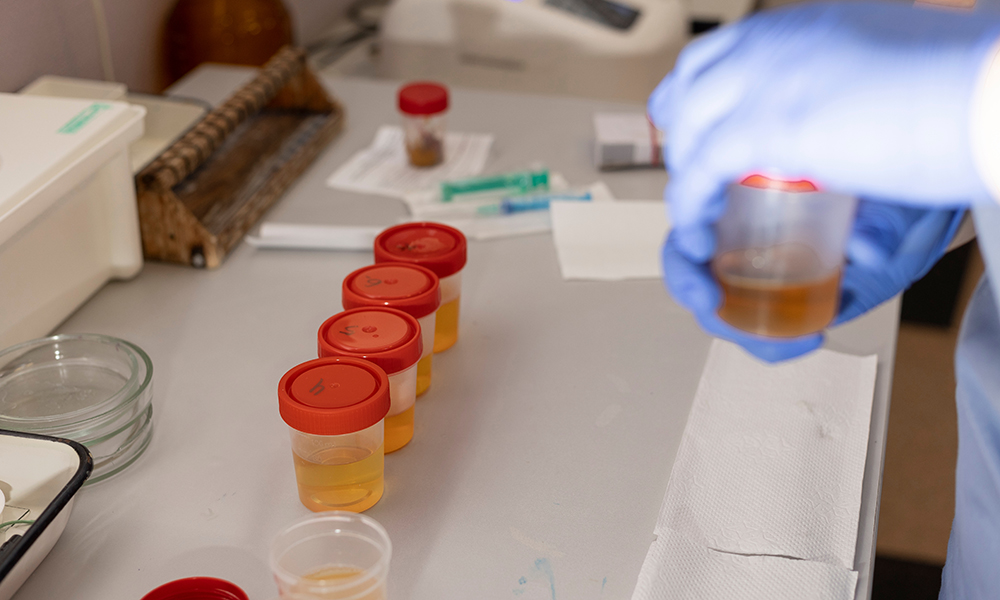
The length of time fentanyl can be detected varies based on the type of test used to screen for use.[10] Different drug tests can show the presence of fentanyl or its metabolites in a variety of biological samples.
Urine Tests
Urine tests are the most common type of drug testing. The window of detection for fentanyl and norfentanyl in urine is approximately 24 to 72 hours after a transdermal patch is removed. With long-term use the window may be greater than 72 hours, because the drug accumulates in body fat with repeated use and clears more slowly. It is also important to note that the standard urine screen does not include testing for fentanyl; a specific test must be performed.
Blood Tests
The window of detection for fentanyl in blood is shorter than it is in urine testing, typically from 5 to 48 hours after the last dose. Because of that short duration, blood testing is used more in clinical emergency situations, and is not usually performed for employment drug testing.
Saliva Tests
Saliva testing is able to detect fentanyl for approximately 1 to 4 days after use. Like blood tests, saliva testing can only provide you with evidence of drug use that occurred fairly recently.
Hair Tests
Hair drug testing has the longest window of detection of any drug test. It is possible to detect fentanyl in hair 90 days or more after the last use. Hair testing is used primarily in legal, forensic, and some types of healthcare settings. It is uncommon to use it for employment drug testing.
Factors That Influence How Long Fentanyl Stays in Your System
Factors that affect how long the drug stays in your body vary from person to person based on a number of criteria, including:
- Frequency of use — Those who use fentanyl frequently will have persistent levels of both the drug and its metabolites in their bodies due to accumulation of drug in the body. Traces of fentanyl can be detected longer in these cases than if someone used it just once.
- Dose amount — Higher doses take longer to metabolize and clear. The amount of fentanyl used directly affects how long it remains detectable.
- Method of administration — When fentanyl is delivered via transdermal patch, it is absorbed into the body over a longer duration than if it were administered via intravenous or mucosal routes.
- Metabolic rate — Metabolism differs among people and is affected by genetics, age, and general well-being. This variability affects how quickly the liver can process the drug.
- Kidney function and liver health — Since the liver metabolizes fentanyl and the kidneys eliminate it, a person with compromised kidney or liver function will have a slower rate of clearance.
- Body composition — Fentanyl tends to be stored in body fat. The higher the percentage of body fat a person has, the longer they may retain fentanyl in their body.
- Use of other substances — Some prescription and illegal drugs inhibit or accelerate liver enzymes associated with the metabolism of fentanyl.
Fentanyl Withdrawal and Why Clearance Matters
Understanding how long fentanyl stays in your body is directly relevant to withdrawal. For most people using short-acting versions of the drug, withdrawal symptoms start between 12 and 24 hours after the last time they used. This timeline can extend if someone is using transdermal patches, as the drug continues to be absorbed after the patch is removed and may have accumulated in fat.
The symptoms of fentanyl withdrawal are often intense. People describe a mix of severe anxiety, deep muscle aches, insomnia, vomiting, and excessive sweating. Because these effects are so unpredictable and uncomfortable, many health professionals suggest that detoxification should happen under medical supervision.[11] Trying to do it alone without proper support can be risky.
In a clinical setting, medical teams may use evidence-based tools like buprenorphine or methadone to manage withdrawal. These medications are used to help ease the body through the withdrawal process and to support long-term recovery.
Which Organs Clear Fentanyl?
The primary organ responsible for metabolizing it is the liver.[12] It converts fentanyl into norfentanyl or other metabolites that are then eliminated from the body by the kidneys in urine.
Because of this, liver and kidney function significantly affect the time it takes to clear the drug. Dysfunction of either organ may cause a person to have longer-lasting amounts of fentanyl in their body, increasing their risk for toxic accumulation.
Fentanyl Addiction Treatment at Paramount Wellness
Fentanyl is one of the more addictive drugs, both psychologically and physically. If you are dealing with fentanyl addiction or a substance use disorder, the best way forward is to seek professional treatment.
At Paramount Wellness, we offer evidence-based addiction treatment programs, including medically managed detox and inpatient programs, as well as outpatient treatment and continuing mental health support. The staff at Paramount understands that fentanyl addiction impacts multiple parts of a person’s life and develops treatment programs that will help them recover from all aspects of their addiction.
Frequently Asked Questions
Related Programs & Therapies
Learn More About Dual Diagnosis Treatment at Paramount Wellness
- Dual Diagnosis
- Depression
- Bi-polar Disorder
- Obsessive Compulusive Disorder
- Post Traumatic Stress Disorder
- ADHD
- Eating Disorder
We’re Glad You’re Here! Take The First Step In Recovery Today.
We’re eager to meet you and help you succeed in your recovery journey. Contact us today to start now.
